
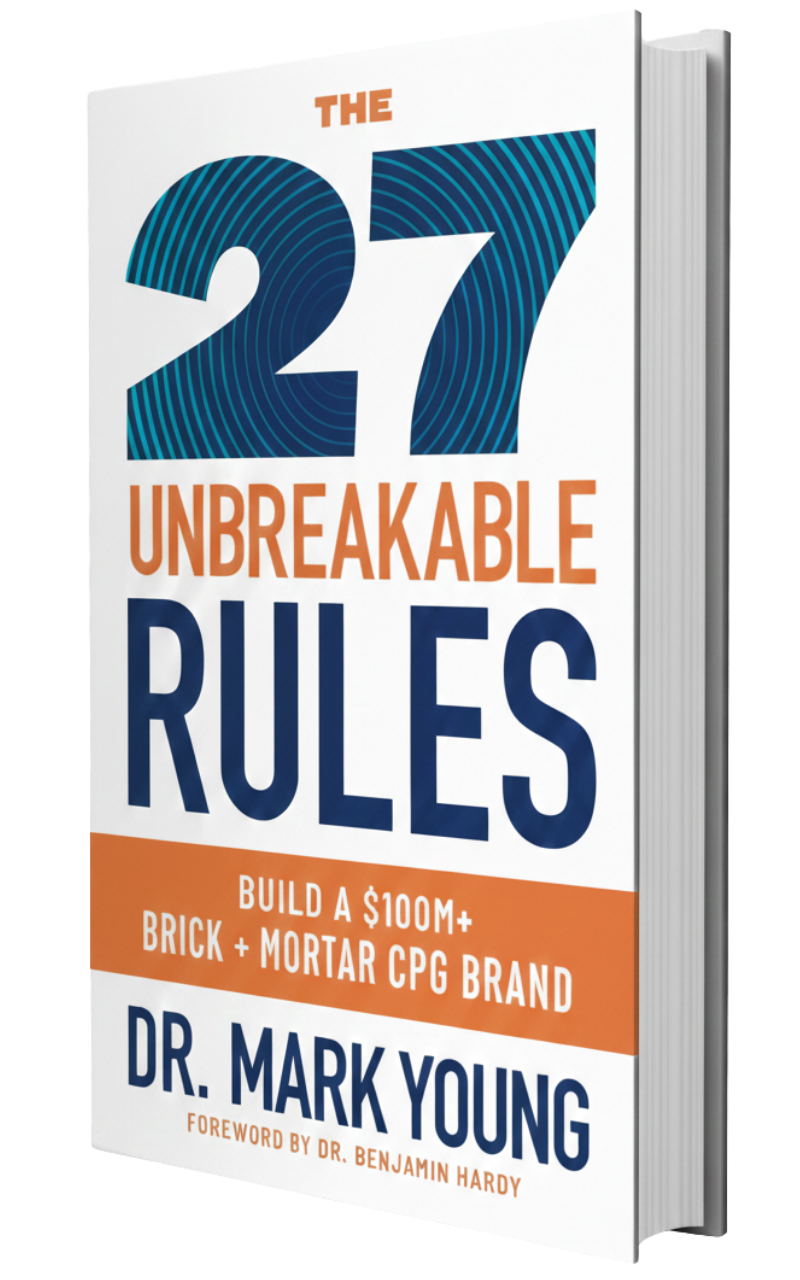
From Amazon #1 Best Selling Author
Dr. Mark Young
We Literally Wrote The Book
for Retail Success
If you are interested in these rules, you are like me; you are a visionary, entrepreneur, a challenger that is driven by passion and purpose. Addicted to more, there is always a better way and when others see problems you see opportunities. You created when others gave up. You heard phrases like "No," "That's impossible" and "You're crazy" so often it almost felt like nicknames. And every day is a new opportunity to create something where nothing exists, to create exponential value and make the world a better place. The best part of all—just like me—your life journey has brought you to the crazy world of consumer-packaged goods.
The goal here is to create a guide that—if followed perfectly—would result in 100% success for you; a literal "Can't Fail" guide to the world of CPG. The 27 rules are simply absolute attributes that every successful CPG entrepreneur has lived by. The more of the 27 rules you adhere to, the better your chances of success. Follow them all and you can't miss.
-Mark Young
This book will transform your life and business. It will transform and elevate how you think about what you’re building and how you market that. Read this book deeply and go big. No more playing small. No more being an amateur.
I consider Mark one of the few people I truly look up to. I love his mastery, his integrity, his faith. I can say with absolute confidence and conviction that Mark understands deeply what he’s doing.
He is a master.

Mark Young thinks differently, works harder and cares more than almost anyone I know in business. He’s spent decades turning ideas into thriving CPG brands, and this book is the closest you’ll get to having him as a mentor. Read it and you’ll understand why so many people trust him.

With decades of advertising experience and a deep knowledge of the expectations of brick-and-mortar retailers, Dr. Mark Young knows what it takes to build a successful brand. Whether looking to scale their business or just starting out, The 27 Unbreakable Rules provides clear, specific knowledge that allows the reader to assess their readiness for the next step. This is a must read for anyone looking to increase their retail sales.

Mark Young understands something that’s becoming rare in today’s abstract, digital marketplace—how to create and grow real products that people see, touch, buy and love to keep buying. In one of the most competitive industries anywhere, he is consistently creating a pioneering company and process that has no competition. The 27 Unbreakable Rules plays out exactly how he does it and how you can also grow your products and marketplace—with Mark’s help.

Are you willing to bet everything you have on your product?
It is impossible to be all in on a product you do not truly believe in. Times are going to get tough; you will need to be all in; if you aren't, no one else will be.
How strongly do you believe in your product? And would you recommend it to your closest family and friends?
Did you make the product because you could or because it was a consumer need?
Often an inventor will bring a product to us that has great technology because some engineers or inventor figured out how to do something, but the product does not actually solve a need. Consumers do not buy products; they buy outcomes. Solve your customer's problems better than every other brand.
What need does your product solve? And what are the hidden, underlying reasons for consumers to buy it?
Who is the real customer for your product? Can you describe them in great detail as if they were a friend?
Oftentimes a new inventor or entrepreneur will contact us with a new item and when we ask them who and what the demographic is they want to reach, they will say "everyone". Very few products appeal to everyone. Know your customers and appeal to a niche.
Are you appealing to a niche that is currently not served or is underserved?
If your product was not on the shelf, could a customer find an adequate alternative to it?
Consumers are not buying at the lowest price; they always buy the highest perceived value. The goal is to become the leader with the best ingredients, the best technology, the best packaging, and most importantly, superior outcomes and performance for the consumer.
If consumers see your product next to your competitor, can they clearly identify and understand why your item is superior and delivers better outcomes?
What products are currently on the shelf that you can replace?
Retail stores are limited by physics; which is a fun way of saying every inch of shelf space in every retailer in America is accounted for. So, in order for your product to go onto a retailer's shelf, some other product must come off. Remember it's easier for a buyer to say "no", than it is to say "yes".
You either need to expand the category, be a trade up, or bring in new money.
Which one of the three pathways does your product fit? Or does it fit into more than one?
What is your one sentence product description?
Retail buyers sometimes see as many as 30 new pitches in a day; they mentally check out quickly. These buyers receive endless product pitches from people looking to have them give up some of their precious, limited shelf space. So they need to see quick success. Retail buyers do not initially care about sales 36 months from now; their focus is on the first 30 days. No buyer is interested in giving us time to develop on their shelf. You need to be a hero from day one.
Can everyone totally understand what you are selling? And can consumers understand why they should buy it?
What are the prime retailers for your product?
Chances are your product does not fit every retailer. Imagine the world of retail as a large funnel. At the very top of the funnel are items used by everyone. As we move down the funnel, we get to items that still appeal to the masses but not everyone. Further down are specialty items, then designer items, and so on. It is important that you have a complete understanding of which retailers are best suited for your products. You need to do the homework and know this up front.
How close to the top of the funnel is your product? And how can you reconfigure your product to fit more mass appeal?
Have all of your claims been reviewed and approved in writing by a qualified FDA/FTC lawyer?
Just because you have created a new product that gets amazing results (especially health claims), it does not mean you can tell anyone about it. For many people in the CPG world, you are making a product that we would refer to as a consumable. These, along with some medical devices, are products that make certain claims or promises, whether they be health claims, or some type of specified performance. You cannot go out and make such claims without the necessary back up or you will find yourself on the wrong side of the table from some agents from the FDA/FTC/USDA and other three- and four-letter agencies.
What classification does your product fit into? And do you need to consider adding in a monographed drug to make your performance claims?
How close to the top of the pricing scale is your product?
As a rule, there is a 10x difference between the cheapest item in a category and the costliest. Many new clients come to us with a low-price strategy. Their thinking is they can make a similar or even better product that will be lower priced than a leading brand, or they will provide a large quantity of the product making it a better deal.
NO RETAILER WANTS THIS PRODUCT!
This means less margin to the retailer and taking up two shelf spaces to do what you are currently doing with just one. This is a losing strategy for the retailer. Don't lose a race to the bottom.
Does your product bring more profit to a retailer? And can you demonstrate to your buyer how your product is a trade up alternative?
What is the bottom and top pricing of your category?
All too often we find brands in their early stages do not charge enough for the product in order to make a profit and stay in business; 40% or 50% won't cut it. There are many, many factors that will affect how you price your product. The traditional way that pricing is determined is called cost plus. This is when we first calculate the "all in landed cost". A markup of at least 5x (preferably 8x) is necessary for long term success.
Are there ways to lower your cost of goods? And are you competing with the other items in your category or are you actually expanding the consumer's at-home options?
Have you identified your hero product?
There is an almost universal trend amongst inventors and entrepreneurs to start inventing the next product as soon as they get finished with the last one. Everyone is under the assumption that they need to have a product line in order to get into retail and to be successful. No retailer is going to say yes to multiple SKUs from a new or untested brand. Shelf space is far too valuable to risk more than one slot on an unproven product.
What percentage of your current sales come from the hero product?
How can you reach new customers or increase your current customer's cart size?
Once you have a hero item that is making retailers money, they will be asking you what else you have. While it sounds exciting, it can be a dangerous time. A common mistake made by many brands is to make multiple versions of the current item. You don't expand the customer base by adding more versions; you actually divide loyal customers across SKUs, which means all the SKUs will underperform. This can also lead to the paradox of choice; the more options you give a consumer, the more they second-guess their own decisions and buy nothing. Your business will actually benefit more from telling the buyer that you have nothing new this year than it will if you give them a new product that cannibalizes your current one.
Are you protecting your hero? And how can you leverage your hero into other products without taking sales away from it?
What is the annual ad spend in your category?
There is more money lost every year by businesses underspending on advertising than has ever been lost by overspending. What I am saying is you need to be the biggest spender in your category, based on your sales. This is critical to have rapid growth, and it is the pathway followed by every dominant CPG brand in the market. This is also why premium brands tend to be the most successful because they have more margin to deploy into advertising and customer acquisition.
What percentage of sales are your biggest competitors dedicating to advertising? And what percentage of sales must you dedicate to advertising to outperform them?
What was your total ad spend last year (not counting trade spend)?
This is one of the most difficult rules for many brand marketers to grasp. When determining the ad budget for the next 12 months we must first decide on our sales goal. Next, we need to determine the percentage of sales needed for the budget to be the biggest spender in the category; meaning, if your competition spends 15% of sales on advertising, you need to spend 17%. But your 17% needs to be on future sales goals, not last year's numbers.
What is your sales goal for the next 12 months? And what must your budget be for the next 12 months to reach the target?
Do you have the best broker for every account?
In the world of CPG, much of the business is transacted by brokers and master brokers. They function as your sales staff but have long-standing relationships with the retailers.
Think of the broker as your talent agent. Typically, most brokers get 5% of actual bottom-line sales of the account they handle. Great brokers spend significant amounts of money on data, so they can provide you with insights and sales data that you cannot afford to buy when starting out. And even better, they know how to interpret the data. Furthermore, great brokers will save you more than 5% just by knowing the right people, the retailer, and knowing what you can and cannot say no to.
Do your brokers participate in new product development and sales projections? And are your brokers monitoring inventory and working to keep replenishment high?
Are all key positions in your firm filled by the best people you can recruit?
The gap between the right and wrong person is not linear; it is exponential. The right person doesn’t add to the outcome, they multiply it. “Whos” come in many different forms. They are your employees, your contract manufacturers, your brokers, your advertising and marketing agency, your lawyer and CPA. You should always hire the very best you can afford and be prepared to hire “Whos” that are outside of what you can afford. The right person frees up your future; the wrong person eats it. Investing in the right person, even one that may cost you as much as double the average salary or retainer, has a 5x-20x impact on the business and profit over an average player. The wrong person is a 2x-10x drain on the company
Are you working with your advertising agency as a partner - not as a vendor? And does every “Who” on your team understand your goals and mission?
Are you building systems to grow exponentially?
Once you go retail, you are all in and it can be a wild ride. You need cash on hand to build product, hold an inventory and to finance receivables, which depending on the account, can be up to 120 days. Also know that you must have inventory on hand for replenishment as these retailers will be sending you weekly replacement orders even though they have not paid for the load in order yet. If you miss delivery dates you will get heavily fined and after three times, you will probably get delisted from the chain. They will not tolerate empty shelves. You will see very quickly there is no crawl, then walk, then run; it is crawl and run your ass off.
Can your supply chain withstand 10x sales growth? And are you prepared for short-term sacrifice for long-term success?
What is your current SOV (share of voice)?
In advertising we focus on a concept called Share of Voice (SOV). This is the math equation of how many dollars are being spent in the market to advertise a specific category of trade versus what your spend is, resulting in what your “share of voice” is in the market. If your product is in a competitive and spending category, what can you do? For emerging or ambitious brands, one of the tricks you can do is to go where everyone else is not. This allows you to stand out in that particular advertising medium.
Have you worked with your advertising agency to discover opportunities your competition has ignored? And what can you do differently than your competition?
Have you created a compelling advertising campaign that will help the retail buyer feel confident in your ability to succeed?
Buyers at chain retailers are under pressure to push their vendors to buy in-store marketing. This can include TPR’s (Temporary Price Rollbacks), BOGO’s (Buy One, Get One Free), in-store signage, circular promotions and even digital campaigns.This is part of the game of retail, and you will have to say “yes” to some items. The truth is that in the long term it is not a benefit to your brand. All you are doing is borrowing next month’s business and conditioning people to only buy your product when it is on sale. Too much of this also cheapens your overall brand. Remember, this is not part of your advertising budget and should not be counted as advertising. It is simply a cost of doing business with a retailer.
Have you discussed with your brokers and/or master broker what the minimum in-store programs are that you need to agree to keep each retailer?
What percentage of your total income is on Amazon?
Amazon is a great place for new and young brands to cut their teeth. Building a strong Amazon business is important and is now the major source of product reviews. These reviews not only matter to your customers but are important for future retail chain buyers. But, as a reminder, 80% of all CPG products are still sold in brick-and-mortar stores, so you are only living in a 20% world if you are limited to online sales. But the risk of being an Amazon-only seller goes far beyond the market cap that comes with digital sales. Amazon can quickly become your competition, kill you with Ad costs, and open you to cheap knock-offs and Chinese counterfeits. It is always dangerous to put all your eggs in one basket no matter who owns the basket, but when Amazon owns it, your demise is likely not if, but when, if this is your major outlet.
Have you been monitoring the market for knock-offs or counterfeit products? And how can you get your sales to a point where Amazon is 15% or less of total sales?
Can your company run and grow with you being gone for a month?
Entrepreneurs are addicts for control. We’re wired that way. And early on in your business, that control is necessary. When you're just getting started, it’s all on your shoulders. You have to be in the weeds. But what makes you successful in the startup phase will kill your business in the scaling phase. But control is an illusion. What we need to focus on in business is not control; it is influence. At a certain point, you turn into a bottleneck. You limit decisions. You slow growth. And worst of all, you make the business emotionally dependent on you. That’s not control. That’s captivity. True freedom doesn’t come from doing more. It comes from building systems, leaders, and structures that can operate independently from your daily involvement.
Is a succession plan in place? Or if a sale is the goal, are you running the company to maximize the sale price?
Are you being honest with yourself about your business?
Let me give it to you straight: every real success I have ever seen—mine or someone else’s—starts with the truth. Not the spin. Not the Instagram highlight reel. The truth. And most people do not want to hear that because the truth is heavy. It makes demands. But the truth is the price of real growth. Without it, everything else is a façade. If you are building a brand, launching a product, trying to fix your life, grow your team, or break through a plateau, nothing works until you face what is real.
The truth doesn’t flinch—and that’s why it works.
What lies are you telling yourself that are hurting your business? And are you willing to kill off anything that is not serving you?
Do you have a hobby or a business?
Let me make this clear right up front: nobody owes you a seat at the table; not in consumer products, not in business, and not in life. If you want to play in the big leagues, you better be willing to prove you belong there. Over and over again. That is the cost of admission. Many times I’ve sat across the table from people who thought having a decent product was enough. They would slap a label on a bottle, spin up a Shopify site, and wonder why Walmart wasn’t calling. The truth? They hadn’t done the work. They weren’t ready. And the market doesn’t reward good intentions; it rewards execution.
This is war, and every inch is earned. Start with the brutal truth.
Are you 100% all in on your brand? And do you have the mindset of getting up more times than you get knocked down?
Have you surrounded yourself with people that possess the traits you do not have?
As an entrepreneur you keep proving the “Negative Nancy’s” in your sphere wrong over and over again, which is awesome, but now comes the other side of the coin. It’s called human conditioning. Our unconscious minds are pattern recognition machines. Unfortunately, this pattern recognition system also seduces you into thinking that only you have the right answers. After all, your mind reasons, “Every time someone told me I was wrong, I was right!”. However, you must surround yourself with people that know more than you and you must be willing to listen. The moment you think you’ve got all the answers in consumer packaged goods, you're already losing. In fact, if you’re not constantly learning, testing, adjusting, and challenging your own assumptions—get out now. The CPG game isn’t for the complacent. It’s for the obsessed.
Know this: CPG doesn’t reward arrogance. It punishes it. Hard.
Is your product about building a great company or stroking your ego? And are you capable of pivoting when needed?
Are you using hope as a strategy?
Everyone wants to know: What is the future of CPG? What trends, what platforms, what ingredients, etcetera are next? You know what? Forget the crystal ball. The best way to predict the future is to create it. You don’t create the future by hoping. You create it by executing relentlessly. By identifying a need before it is mainstream. By solving a pain point the consumer does not even fully understand yet. You do it by listening harder, moving faster, testing smarter, and never assuming yesterday’s wins will get you through tomorrow. Creating the future takes vision. It takes guts. It takes the kind of obsession with excellence that keeps you up at night because you know you’re onto something real.
So stop asking, “What’s going to happen?” Start asking, “What are we going to make happen?”
Are you constantly improving? And do you have a clear vision for the future with timetables and deliverables?
Is your product really the best in class?
Best in class is not a title you declare. It is a standard you live. If you are not playing to be best in class, what are you even doing in the CPG industry? This is not a space for “good enough.” It is not a place for the second-tier, half-committed, or overly cautious. In CPG, you either lead your category or you disappear into the noise. And if you’re not willing to take risks, then don’t be surprised when your brand fades into the background.
Here is the truth: nobody remembers the “safe” brands. Consumers don’t fall in love with average. Retailers don’t give premium shelf space to the bland. And investors don’t bet on companies playing it small. The only brands that win are the ones that go all in, on quality, on identity, and on risk.
Are you playing not to lose or playing to win? And are you ready and willing to take big, calculated risks?
Are you all in? And have you given up on plan B?
Let’s get something straight right out of the gate: you cannot be partially pregnant. You either are or you are not. And the same brutal truth applies to the consumer packaged goods (CPG) business; you are either all in, or you’re already dead and don’t know it yet. This business is not for the faint of heart. It isn’t for tourists. It isn’t for dabblers, dreamers, or dilettantes. If you do not have the stomach to bleed a little, hustle hard, and make some enemies along the way, then do yourself a favor and walk away now. But if you are all in—really all in—when you get knocked down (and you will, over and over) you will get up every damn time. You’ll pivot. You’ll iterate. You’ll find the angle. And eventually, you’ll win. Not because it was easy, but because you refused to quit.
So... are you in?
Be warned, these are rules, they are not suggestions, and this abridged version of The 27 Unbreakable Rules is only the start. If you would like a free audio copy of this book, you can download your FREE copy here.
If you're ready to push on and build something great in the CPG world, Jekyll + Hyde Labs can help you turn your challenger product into a 100M+ brand.
Schedule Your Meeting Today